
Key takeaways:
- Mid-market fund managers have remained active dealmakers despite the more challenging economic backdrop.
- These funds typically outperform megafunds, though with a considerably wider dispersion.
- The segment has structural advantages over larger-cap investments that we believe can make it more resilient through all parts of the economic cycle.
Private equity’s largest funds tend to attract industry’s headlines, so it can be easy to overlook that the asset class stretches far beyond deals involving household names and into the vast plains of the mid-market.
It’s worth noting that there is no universal definition of mid-market in the private equity industry. At Moonfare, for example, we consider mid-market companies to have an enterprise value of between $50 million and $500 million. Some firms identify mid-market target companies as low as $5 million, while others stretch to as high as $1 billion. Mid-market funds also vary considerably in size, depending on the firm’s definition. For Pitchbook, its mid-market data is based on activity by buyout funds that have raised between $100 million and $5 billion.
Ongoing resilience
Whatever the definition, the segment's recent record is defined less by growth than by steadiness. In the US, for example, mid-market deal value held broadly flat in H1 2026, according to Pitchbook,¹ with nearly 2,000 deals worth $193.6 billion.
The smallest deals showed the most momentum recently: transactions between $25 million and $100 million totalled $16 billion in Q2, up 70.6% year-on-year. This is the part of the market which is normally least exposed to capital-markets conditions, since deals at this size rely less on leverage, are often driven by founder succession rather than valuation timing and frequently take the form of add-ons that sponsors can pursue regardless of the financing climate.
Exits in mid-market also show steadiness — despite the fact that the value of sales slipped 5.2% year on year to $55.4 billion in the first six months, while exit count edged up to 473.² The trend runs toward fewer but larger exits, suggesting buyers are paying up for the best assets which mirrors the broader PE market. For LPs, the practical consequence is slower and more uneven distributions.
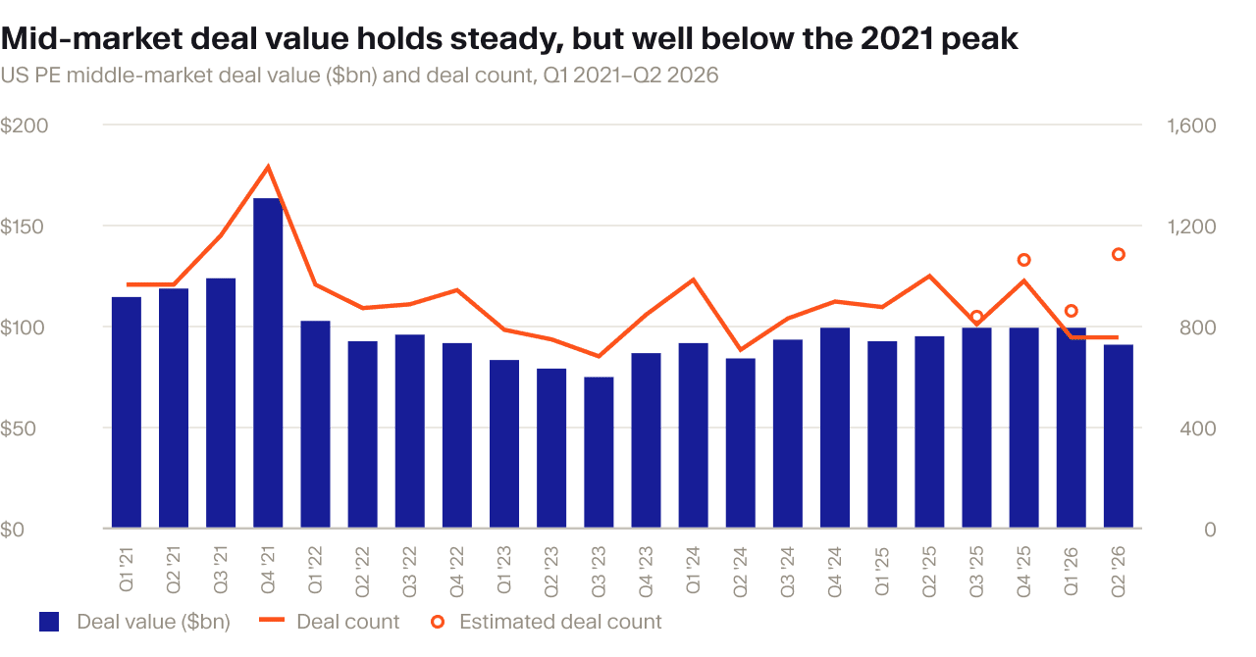
There has been good news from mid-market funds at the portfolio level. Companies included in the Golub Capital Altman Index grew revenue by 3.1% year-over-year in the first two months of the second quarter of 2026.⁴ Earnings are up by 3.7% year-over-year during the same period. Despite meaningfully lower valuations, private equity-backed mid-market companies are growing faster than their peers in other categories.
Meanwhile, fundraising "remains relatively healthy and is pacing slightly better than in 2025", with nearly $70 billion raised by US funds in the first half of the year, per Pitchbook. Mid-market managers' strongest fundraising argument is their potential to outperform megafunds, though with wider dispersion: a higher ceiling and a lower floor. For buyout vintages 2005–2020, for example, the top-to-bottom quartile IRR spread is 8.3 points for mega-funds, versus 12.6 points for middle-market buyout.³
What are mid-market fundamentals
There are several fundamentals underpinning the mid-market’s resilience over recent times (and, indeed, over the long term), making it potentially an attractive area for investment.
Relatively low debt levels. Mid-market deals tend to be financed with a lower debt to equity ratio than larger transactions.⁵ This clearly has advantages for existing portfolios companies at a time of higher interest rates.
However, it is also a benefit when it comes to getting new deals over the line: mid-market private equity funds targeting companies with less than $50 million of EBITDA can often bridge new deals with equity (with an option to refinance at a later date) because the individual cheque sizes are smaller and therefore do not leave sponsors with too much exposure to individual assets.
Deep pool of opportunities. The mid-market is large — in the US alone, there are around 300,000 businesses in this segment generating $13 trillion of revenue, according to JP Morgan Chase data.⁶ It’s therefore a deep and broad pool for private equity fund managers to select deals from and it stretches across a range of industries, sectors, niches and stages of development, including, in some instances, start-ups.
That said, mid-market fund managers predominantly target established, mature businesses that benefit from private equity’s value creation tool kit and capital to unlock growth potential.

Alpha generation. Mid-market companies are usually ripe for operational improvements and expansion. They often need private equity to do a fair amount of heavy lifting, such as professionalising their structures and processes to create a solid foundation for growth.
They also frequently operate in fragmented areas and so lend themselves to buy and build strategies that consolidate industries, increase market share, and bring businesses to new geographic and/or product markets. These improvements and growth potentials — with middle market funds typically being the first source of institutional capital for their targets — offer a clear path to increased valuations at exit, which can often withstand periods of multiple contractions, like those we see today.
Over the past ten years, revenue and EBITDA in private equity-backed mid-market companies have increased by an average of 115% and 124%, respectively, according to analysis by Morgan Stanley.⁷
Specialist sector expertise. Many mid-market private equity houses focus on particular areas of the economy. Over the past decade or so, many have built up teams with sector investment and/or operational experience, which helps them identify high potential companies with strong growth prospects and provide targeted support for expansion.
Oakley Capital, for example, invests in technology, consumer, education and business services. Verdane, meanwhile, focuses on technology-enabled growth businesses in Europe with two core themes — digitalisation and decarbonisation.
Robust and varied exit routes. Realising investments and returning capital to investors is obviously the ultimate aim of any private firm. And here, the mid-market benefits from some structural advantages.
Trade sales are a clear path, as are sales to a wide range of other financial sponsors — more so than mega-deals that may be too large for most private equity firms.
Finally, the relatively new kid on the exit route block, the GP-led single asset continuation fund, has become particularly popular among mid-market players as a way of returning capital to investors. The secondaries funds financing these deals have shown a preference for this segment of the private equity space. This is partly because secondaries players need adequate diversification in their portfolios and are therefore more able to finance transactions below the mega-deal level.
A potential evergreen strategy
The private equity mid-market has shown resilience during what has been a challenging time for private equity and the economy more generally. Yet it also has a range of attributes that make it an enduringly attractive area for investment at any point in the cycle.
With its lower entry valuation points, lower leverage, greater headroom for value creation and deeper pool of opportunities, the lower profile mid-market has the potential to generate better returns than its better known large-cap cousin.