
Key takeaways:
- “Software companies are trading at 5x revenue, which we haven’t seen in over a decade. There are some that deserve to trade at that, and others that don’t,” argue software specialists.
- Recent deals show that fund managers already have a clearer picture of which software categories keep their pricing power under AI and which don't.
- Software economics today rests on workflow embeddedness, regulatory complexity, proprietary data and switching cost.
Software that's deeply embedded, costly to switch and protected by data or regulation is seen as best positioned to survive an AI-first economy. For investors in software funds, that means pressure-testing managers on whether they can identify and actively strengthen the businesses that meet that bar.
Early 2026 brought a wave of advanced agentic AI products that threatened the assumption underneath a decade of SaaS growth: that recurring revenue scales with the number of employees who need a license. If one AI agent can execute the work that previously required five licensed users, the business doesn't need five seats anymore, and the vendor loses four-fifths of that account's recurring revenue.
Stock markets responded to that realisation with a sharp repricing. The iShares ETF that tracks an index of US software companies plunged 24% in the first quarter of 2026, its worst quarterly performance since 2008.¹ The decline has since partly reversed, following earnings from ServiceNow, Salesforce and Snowflake showing AI could add revenue rather than simply cannibalize it. The ETF is down just 3% for the year as of August 10 but still hasn't caught up to the broader market; tech-focused Nasdaq, for example, is up 15% over the same period.²
Private markets impact
Private marks also moved down, but not as sharply as their public equivalents. Bain's proprietary MSCI analysis of Q1 2026 buyout marks shows private software valuations down roughly 8% overall. The decline was uneven by geography: US marks fell 8.9%, Europe just 4.2%.³
Private marks reprice slower because there's no ticker forcing daily updates, but that's only part of the explanation. The more significant reason is that public multiples re-rated an entire category in a matter of weeks, while GPs underwrite company by company, with visibility into cost structure, customer concentration and AI exposure that a public market can't price at the index level.
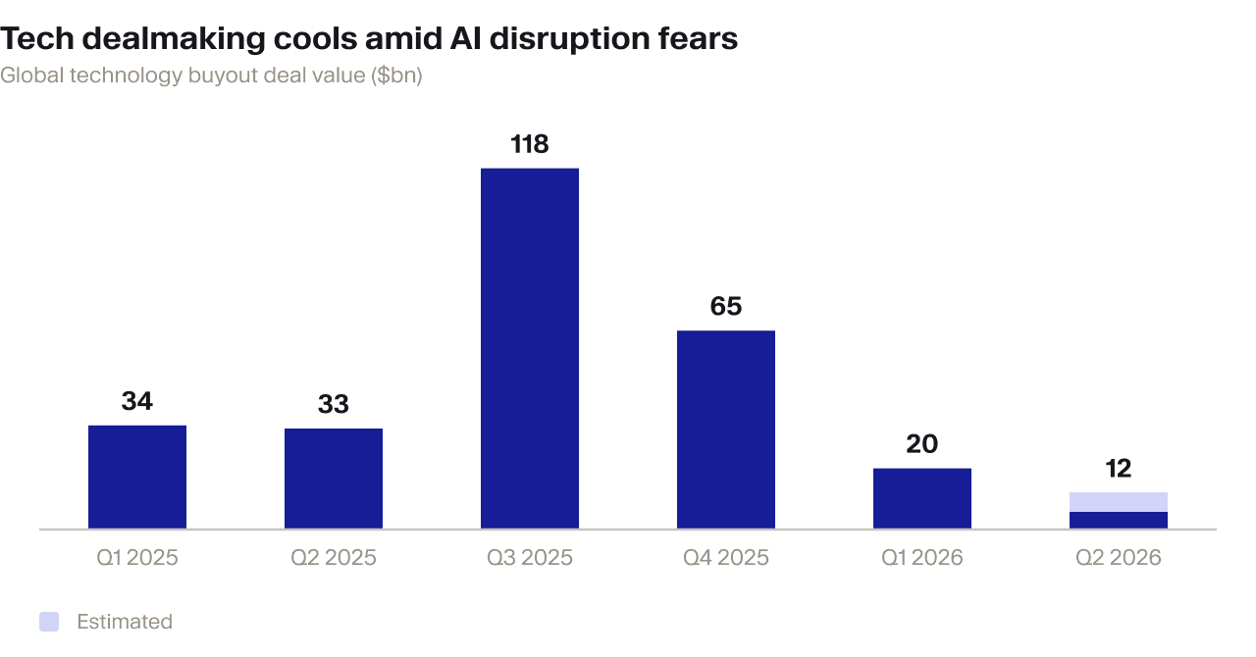
Still, the uncertainty around AI's impact has made sponsors much more cautious. Bain's data shows technology buyout deal value fell 70% between Q4 2025 and Q1 2026, with the count of deals over $1 billion dropping from 15 to just 4.⁴ Value fell 70% in the same period, which is the weakest start to a year since 2020.
GPs are declining to underwrite when nobody could yet say which companies were AI-exposed and which weren't. We see it as a pause for diligence that has since started to lift.
What software deals today have in common
Deal count is historically thin, but it’s showing signs of a recovery. Managers now have a clearer picture of which software categories keep their pricing power under AI and which don't. We found that the pattern across recent deals is consistent.
The software specialist Hg's $6.4 billion take-private of OneStream, the largest software platform acquired so far in 2026, is a good example.⁵ OneStream combines and analyses all kinds of financial data in one platform, providing clients with a deep ecosystem of custom applications and workflows that makes switching to other providers an expensive and complicated process. AI has the potential to reinforce this competitive advantage — by, for example, detecting anomalies through scanning thousands of transactions and flagging unusual patterns.
Another recent Hg investment is a $500 million transaction into Rightsline, a California-based company that manages rights and royalties for clients including Disney and Warner Bros Discovery.⁶ The Rightsline's "moat" is deemed hard to replicate, since the company operates in a compliance-heavy niche too specific for an AI-native challenger to easily route around.
Thoma Bravo, one of the world's largest software-focused investment firms, took over Kneat for $466 million.⁷ The Ireland-based provider digitises data for integrity and traceability, primarily in pharmaceuticals, biotech and medical devices. Thoma Bravo believes this positioning gives Kneat "a critical foundation for the confident deployment of AI across regulated environments."
These businesses defend their position with proprietary data, deeply embedded AI that automates and orchestrates work. They are considered mission-critical, often middle-market and vertical SaaS businesses, built for customers who can't produce the workflows themselves and are constrained by regulatory complexity that makes switching expensive.
LPs demand differentiation
It's too early to say with confidence how lasting the AI disruption will prove for software as an asset class. What is clear already is that LPs are becoming more selective about which software managers get their capital.
This is evident in recent fundraises. Francisco Partners, one of the most established software investors with over 450 transactions, raised more than $21 billion across two funds to capitalize on software dislocation.⁸ “Software companies are trading at 5x revenue, which we haven’t seen in over a decade. There are some that deserve to trade at that, and others that don’t,” said Dipanjan “DJ” Deb, the firm's co-founder and CEO, who believes that their job is to try to arbitrage that gap.⁹
Main Capital Partners, another European sector leader with nearly 50 enterprise software exits to date,¹⁰ closed two new funds at a combined €5.25 billion in just under six months, more than twice the size of their predecessors and the largest private equity buyout fundraise in Dutch history — both funds oversubscribed, with a re-up rate above 120% from the existing LP base.¹¹ The firm frames AI as rapidly reshaping how software is built, sold and scaled, creating a new frontier of growth opportunities across healthtech, govtech and infrastructure.
Individual firms have shared various views on the risks and opportunities of AI. Alpine Investors founding partner Mark Strauch, for example, argues that moat alone isn't enough. The winners will incorporate AI into the product itself and price on outcomes rather than seats, effectively becoming "vertical AI" rather than vertical SaaS.¹²
Thoma Bravo's founder Orlando Bravo has been publicly declaring the "SaaS apocalypse" over, framing AI as a tailwind rather than a threat to the firm's roughly $200 billion software portfolio.¹³ In his view, software applications remain the primary, trusted gateway for enterprise AI adoption.
Robert F. Smith, the founder and CEO of Vista Equity Partners, views AI disruption as a next massive expansion phase.¹⁴ He believes software is shifting from simple digital tools into active "digital labor". A core tenet of Smith’s AI strategy is that enterprises must maintain strict control over their data and workflows.¹⁵
What this means for allocators
For allocators into software funds, the impact of AI changes what the vetting process needs to establish.
Historically, underwriting a software GP meant assessing sector experience, deal sourcing and value-creation track record. That's no longer sufficient on its own. A fund's process now also needs to demonstrate it can distinguish a structurally defensible business from one that has so far avoided disruption. The points below can help guide your manager assessment:
- Software defensibility: The question behind any portfolio AI exposure is whether its economics rest on workflow embeddedness, regulatory complexity, proprietary data and switching cost, or on growth and market position that AI can commoditize.
- Horizontal vs. vertical exposure: Horizontal SaaS sells functionality that a foundation model can easily replicate while vertical SaaS typically operates on functionality too specific to generalise, such as industry-specific compliance or proprietary workflows.
- AI-exposure framework: Does the GP have a specific methodology for classifying portfolio companies by AI disruption risk? Most software companies aren't uniformly exposed (a platform can have a defensible core and a vulnerable add-on module) and a framework that only scores at the company level could miss where the erosion happens first.
- Value-creation capabilities: Does the GP's operating playbook include the ability and the right people to redesign a portfolio company's pricing model, i.e. moving from per-seat to usage or outcome-based, or integrate AI into the product itself?
- Discipline under pressure: Did the GP pull back on deal activity during this year’s volatility, or instead push through at a discount to keep deploying dry powder? In our view, discipline under pressure is a better predictor of underwriting quality than deal count alone.
- Exit-path concentration: Does the fund's return model depend on a single exit channel? What happens to underwriting if that channel is constrained when the fund needs to exit?
- Reliance on leverage: How much of the fund's return expectation depends on multiple expansion and leverage versus operational value creation? A strategy built around leverage is more exposed to a tightening credit market than one built around margin and retention improvement.
We see that software investing is consolidating around a smaller set of opportunities. Those managers who will identify these opportunities correctly, are competing against potentially fewer bidders at more attractive valuations. In our view, this is an environment that has historically produced private equity's strongest vintages.