 14
14The long-term numbers favor private markets. Higher returns, better crisis resilience and stronger portfolio outcomes stand out over the past 25 years, our research has shown.
Private assets have been attracting growing attention as investors look for ways to diversify beyond public markets, especially at a time when public equity valuations are hovering near record highs.
One challenge, however, is that reliable data on the performance of private equity and venture capital can be difficult to access. Despite the size and importance of private markets, there is still far less performance analysis available than there is for public equities.
With this white paper, we help close that gap by offering a clearer perspective on the long-run performance of private assets. We explore:
- Performance relative to public markets
- Behavior within diversified portfolios
- Resilience after economic shocks
- Performance across different business cycles
What the research shows
Better long-term returns
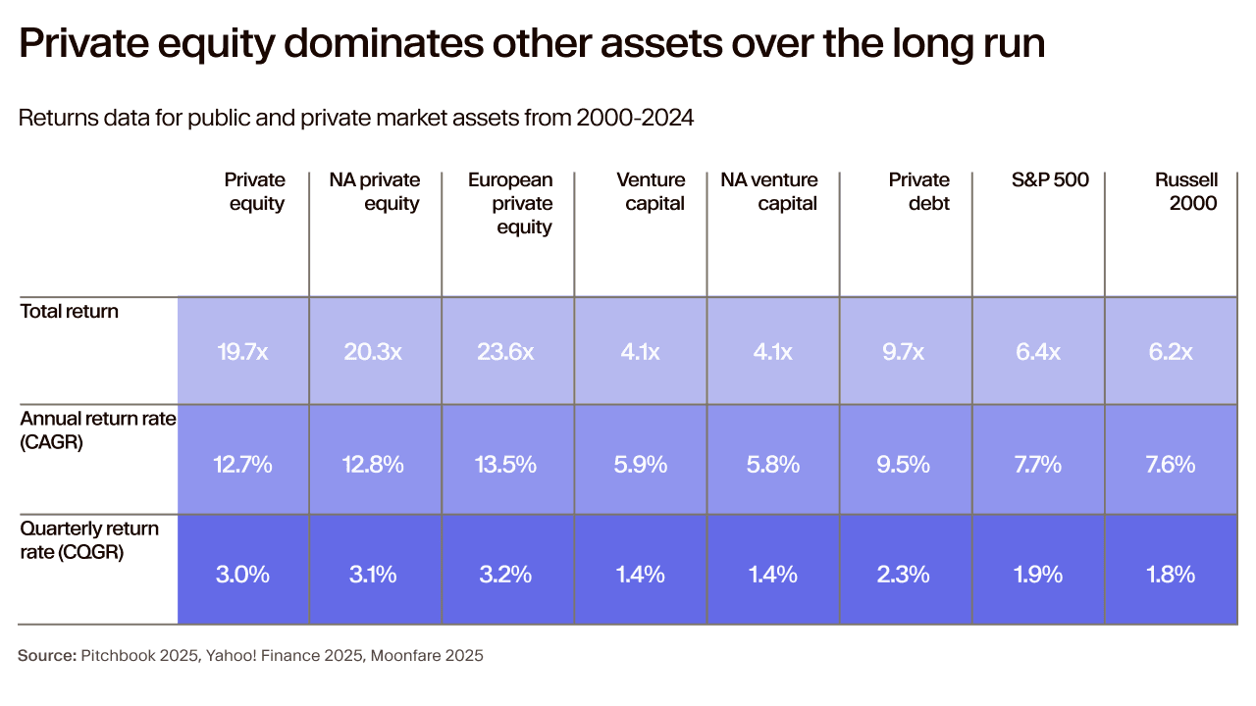
Over the last 25 years, the majority of private assets have produced better returns than public assets. Private equity has grown by 12.7% annually, while the S&P 500 by 7.7%.
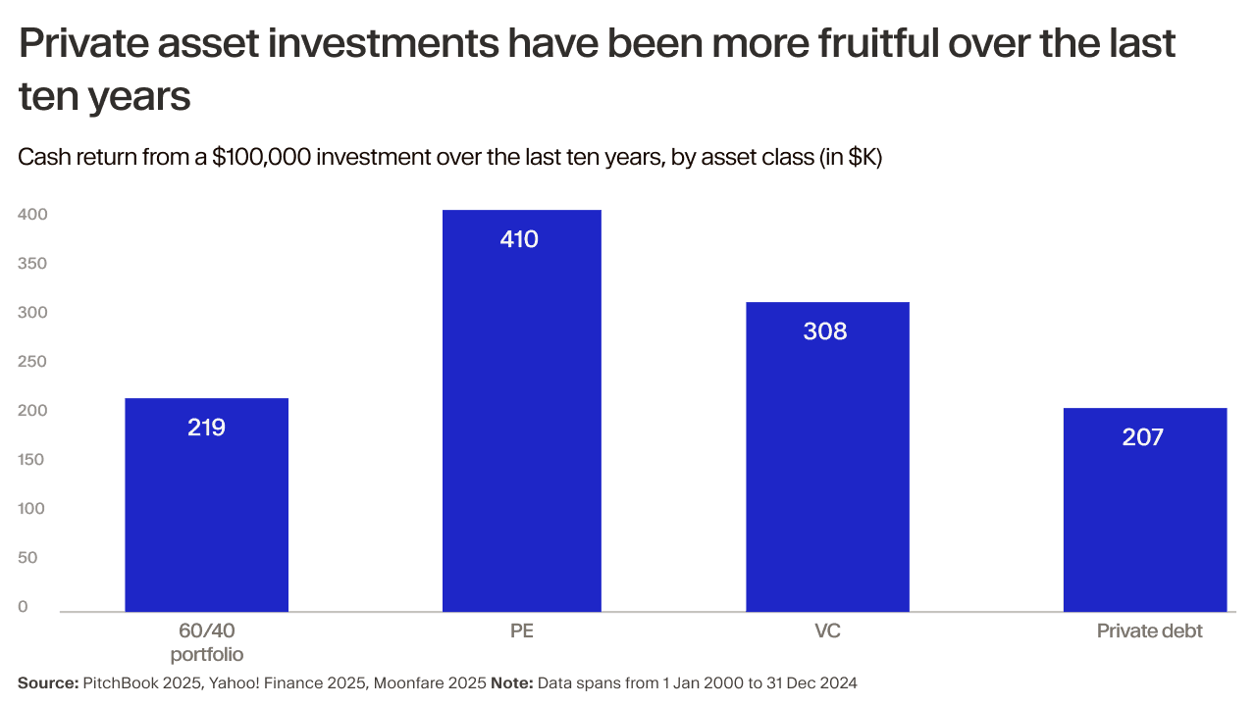
Amongst the private asset classes, private equity — in Europe and North America — has been the best performer, followed by private debt and then venture capital.
Resilience in crises
Private equity outperformed the S&P 500 in every major crisis since 2000, including the Dot-com crash and the Global Financial Crisis.
During the GFC, for example, the S&P 500 fell by as much as 45.8%, while the private equity index declined by 24.8%.
We believe this difference reflects private equity’s structural flexibility, active management and resilience during periods of market disruption.
Strong performance across business cycles
Another important aspect of private asset performance is how well different types of assets perform in different phases of the business cycle.
In the past, private market assets have generally outperformed public markets in economic slowdowns and contractions, potentially protecting investors against downside risk.
Potential for improving portfolios
In our research, there is plenty of evidence to suggest a significantly different profile in the performance of private assets compared to equities. This quality can make them valuable in the context of portfolios.
For example, a 50/30/20 portfolio would have outperformed a standard 60/40 portfolio of stocks and bonds over every study period for the last 25 years.
We also compared the performance of individual private assets and portfolios. While $100,000 invested in a global 60/40 portfolio 25 years ago would be worth nearly $500,000 today, the same investment in private equity would have grown to almost $2 million, with similar outperformance over a 10-year period.
About the data
Our analysis uses the PitchBook Private Capital Indexes, which provide quarterly data from January 2000 through December 2024. These indices are built using fund cash flow and net asset value (NAV) data, making them a useful way to compare private market performance with public equities.
To benchmark against public markets, we use the total return indices of the S&P 500 and the Russell 2000. The S&P 500 represents large US companies, while the Russell 2000 tracks small-cap stocks.
Important notice: This content is for informational purposes only. Moonfare does not provide investment advice. You should not construe any information or other material provided as legal, tax, investment, financial, or other advice. If you are unsure about anything, you should seek financial advice from an authorised advisor. Past performance is not a reliable guide to future returns. Don’t invest unless you’re prepared to lose all the money you invest. Private equity is a high-risk investment and you are unlikely to be protected if something goes wrong. Subject to eligibility. Please see https://www.moonfare.com/disclaimers.