




Open-ended funds. Curated to our standards.
Open-ended funds that meet our high institutional standards but offer greater control. Put capital to work immediately with a single investment. Access to periodic liquidity windows.¹
Immediate exposure, no blind pool
The underlying holdings are fully visible. These opportunities offer immediate exposure to an established portfolio.
Easier to manage
With commitments paid upfront, there’s no need to track multiple capital calls and distribution notices over the fund lifecycle.
Liquidity windows
Portions of these funds can be redeemed each quarter or semi-annually, rather than only when the investment matures.²
¹ Liquidity is not guaranteed. Subject to an initial lock-up period. ² Some open-ended funds may not offer this feature.
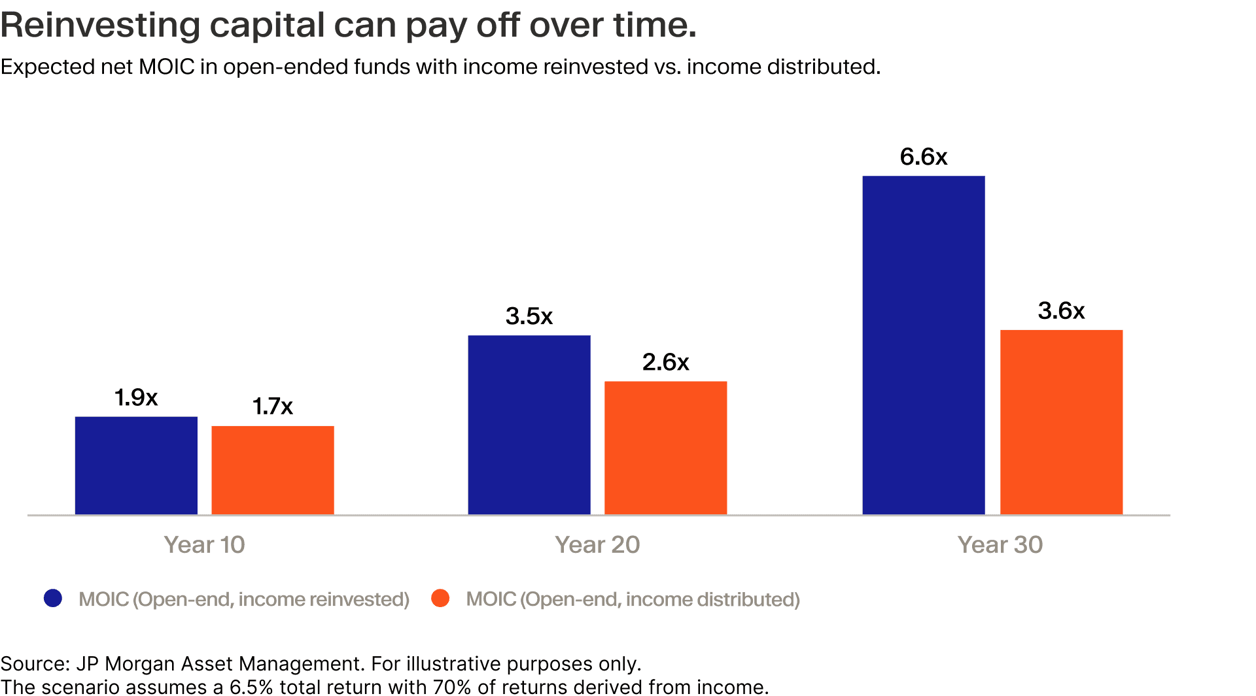
Opportunities for tax-efficient compounding.
With most open-ended funds, distributions are automatically reinvested within the fund, rather than returned to an investor's account as idle cash. This uninterrupted exposure is what makes compounding work, turning years of steady returns into meaningful performance. Note that most but not all open-ended funds offer this feature. This uninterrupted exposure is what makes compounding work, turning years of steady returns into meaningful performance. Note that most but not all evergreen funds offer this feature.
The key to successful open-ended investing.
Access to managers who can consistently source high-quality deals is critical. This keeps capital in a fund that's continuously gaining value, which accelerates compounding. However, not all managers can deliver. That's why Moonfare applies a consistent, institutional-grade due diligence process to all opportunities on the platform, including open-ended funds. In fact, fewer than 5% meet our standards.
Meet the team.
Moonfare’s selection team is led by our Head of Private Equity, Philip Meschke. The Moonfare Investment Committee is made up of industry heavyweights who have held leadership roles at KKR, Permira, Union Bancaire Privée, Apax, Lehman Brothers and other leading firms.
Investment CommitteeInvestment Team
steffen pauls image
Steffen Pauls
Founder and Co-CEO
magnus grufma
Magnus Grufman
COO and Managing Director
Sanjay Gupta
Sanjay Gupta
Independent IC Member
Bill Murphy
Bill Murphy
Independent IC Member
Drag to explore
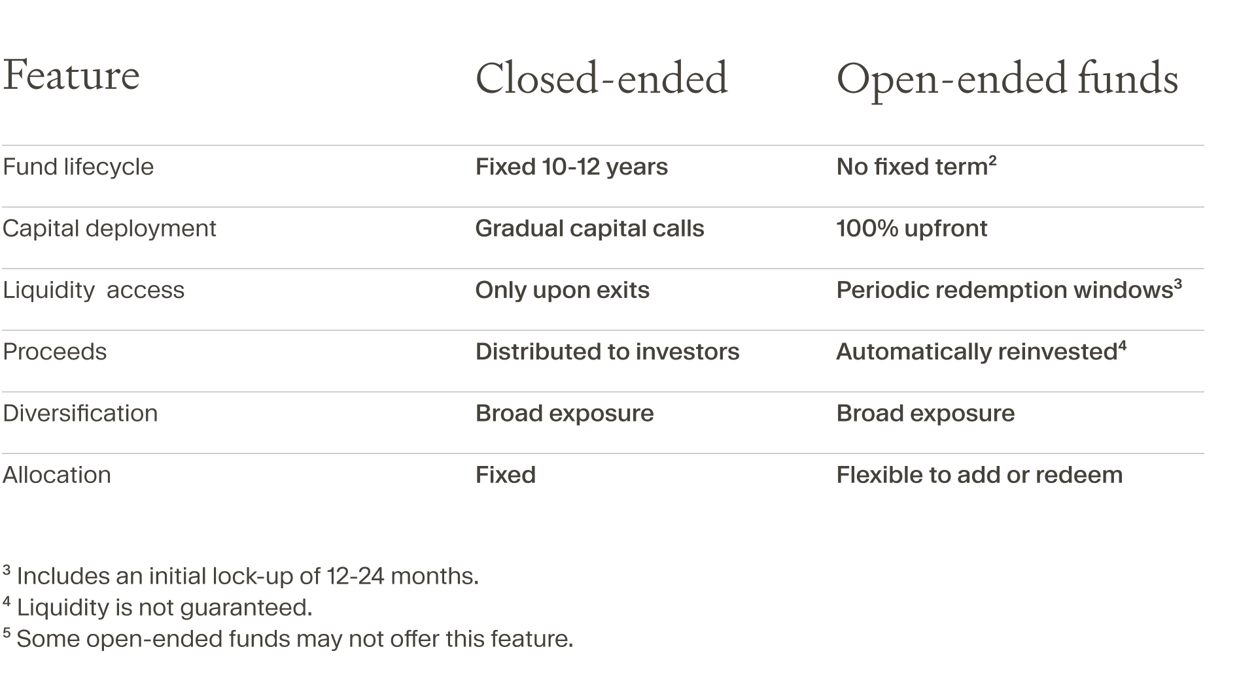
The key differences explained.
Understanding your liquidity options.
Most open-ended funds offer quarterly or semi-annual redemption windows, when all or part of the capital can be requested. However, liquidity isn't guaranteed. If redemption demand is high, each request may receive a proportional share. And most funds include an initial lock-up period of 12 to 24 months. It's worth knowing before committing.

Learn more about evergreen funds.

What makes the strategy so attractive in 2026?

Demand for liquidity is creating space for open-ended strategies.

The role of open-ended funds in your portfolio.

How these funds complement closed-ended funds in today's portfolios.

Inside an evergreen fund.

Redemptions, gating and liquidity explained.

A simpler entry into private markets.
Compared to closed-ended funds, open-ended funds can be easier to manage. These structures allow individuals to invest once in an established portfolio, giving full visibility of underlying assets.⁶ Capital deploys immediately, not gradually over three to five years like traditional closed-ended funds. No need to keep cash reserves while waiting for unpredictable capital calls. When circumstances change, there may be access to periodic liquidity windows offering some liquidity over the term of the investment.

⁶Source: Neuberger Berman, Comparing Open-ended and Traditional Fund Returns in Private Equity, September 2024
Building on an existing private markets allocation.
Open-ended funds allow an allocation to be fine-tuned as needs evolve, a key difference from closed-ended funds. A position can be topped up for more exposure or trimmed through quarterly or semi-annual liquidity windows if the opportunity presents itself. This helps keep capital deployed and working between the capital calls and distributions from closed-ended funds.⁷

⁷Some evergreen funds may not offer this feature.
Rebalance a private markets portfolio.
Open-ended funds allow an allocation to be fine-tuned as needs evolve, a key difference from closed-ended funds.⁸ A position can be topped up for more exposure or trimmed through quarterly or semi-annual liquidity windows if the opportunity presents itself. This helps keep capital deployed and working between the capital calls and distributions from closed-ended funds.
⁸Institute for Private Capital, Evergreen vs. Drawdown Funds: Risk, Returns and Cash Flows, June 2025
