
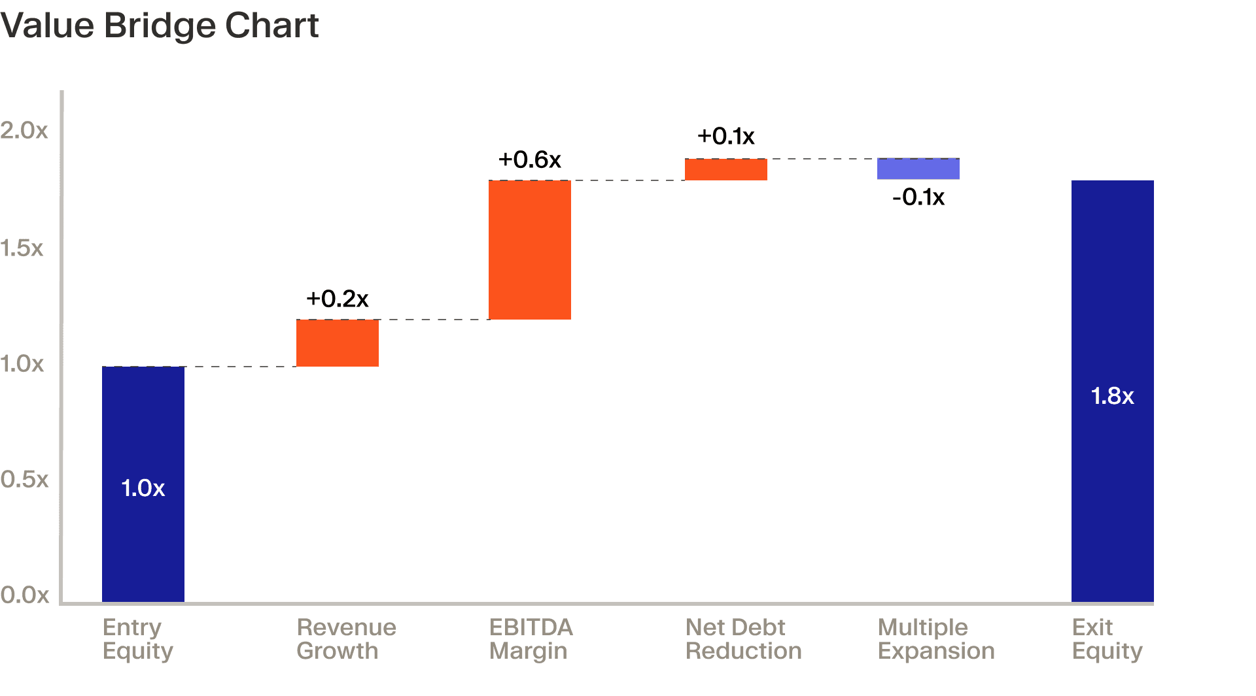
Creating a value bridge, which maps EBITDA at entry to projected exit EBITDA, typically takes around two hours when done manually. With AI tools, the exercise produces the same or more sophisticated results in roughly five minutes. For our investment team, building AI-assisted value bridges and other models has already become a routine practice.
Although we are still in the early days and not every workflow is ready for full automation, the direction is unmistakable - artificial intelligence will fundamentally improve how firms source deals, run due diligence and track portfolio performance.
We estimate that AI-assisted due diligence alone could reduce time spent by around 30–40%, potentially freeing up 10 hours a week per team member. Multiply that across a team of analysts over a full year, and the cumulative effect on output and coverage is substantial.
Already making a difference
Currently, AI excels at speeding up repetitive tasks: document analysis and summarisation, day-to-day communication support and, to a degree, financial modelling. Automating data structuring and formatting gives the team more room for interpretive work like stress-testing assumptions and evaluating risk.
In deal sourcing, AI systems are scanning market data at scale, identifying patterns across vintages and surfacing opportunities that manual screening would likely miss. This faster pattern recognition carries real economic weight as access and timing are among the strongest determinants of fund performance.
Moonfare is particularly focused on bringing AI into sourcing mid-market opportunities. The sheer number of managers, the fragmentation and the reliance on personal relationships make full coverage nearly impossible without it. In practice, that means building tools that track manager timelines, alert us when managers come to market and scan social networks to find warm introductions. The same infrastructure extends to direct deal screening, where AI helps surface and evaluate VC opportunities at a pace and scale that manual processes simply cannot match.
Over time, our ambition is to build a series of connected AI agents, each responsible for a distinct stage of the investment process.
From weeks to days
Further along the investment chain, AI has already helped compress competitor analysis and internal financials review from weeks to days. Firms are training generative AI on prior IC materials to produce first-draft investment summaries that teams can then refine. PwC's benchmarking places productivity gains on these diligence tasks at 35–85%.¹
The benefits reach beyond deal selection. In portfolio monitoring, firms are adding generative AI to their data platforms to track qualitative inputs more consistently, moving from static reporting toward continuous, multi-dimensional tracking.
Over the next five years, AI is expected to connect sourcing, diligence, value creation and exit into a continuous feedback loop. Every data point, from a term sheet to a board deck, will sharpen how a firm underwrites future deals.
AI agents will monitor markets in real time, flagging competitive threats and surfacing growth opportunities as they emerge. According to a 2025 survey by Pictet, over 60% of respondents already attribute revenue increases at portfolio companies to AI.² Firms are increasingly underwriting AI-driven value creation at entry rather than treating it as discretionary upside. AI is becoming part of the investment thesis itself.
Where the line falls
For all the momentum, real constraints remain. Data quality is a persistent issue. Investment data is often scattered across platforms and stored in inconsistent formats, which limits the scope of what AI can produce.
The even deeper challenge is governance. When AI touches the investment process, firms need clear frameworks for where automation ends and human accountability begins.
At Moonfare, we are deliberate about where that boundary sits. It’s humans who handle everything that requires judgment: reading across due diligence, interpreting what a manager says and doesn't say or weighing conflicting signals from the market. The Investment Committee makes the final decision, and it will remain entirely human.
Ultimately, the winners will be firms that adopt AI fully but keep human judgment at the centre. However, getting that balance right may prove as consequential as the technology itself.