
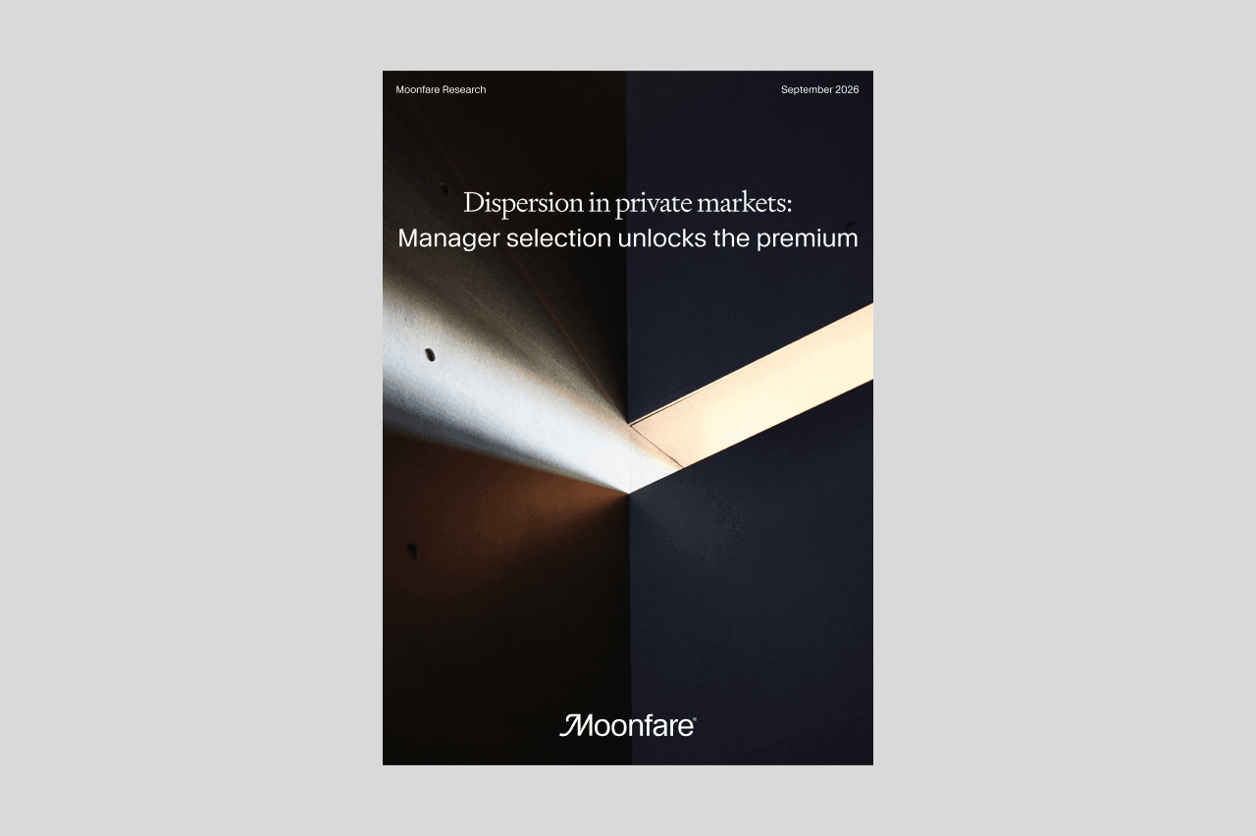
White paper
Why return dispersion in private markets matters
September 15, 2026
31 pages | 15
15
15What does 25 years of private markets data say about dispersion of returns? How often do fund managers repeat in outperforming competitors? Is manager selection more than guesswork?
A new Moonfare study offers new insight into how small differences in annual performance compound into very large gaps in value over a typical 10-year fund life.
To learn more, download the full report by filling in the form.
About Moonfare
Moonfare is a leading global private markets platform and asset management group, giving qualified individual investors and family offices access to the private markets.
More white papers
Why return dispersion in private markets matters
The 50/30/20 portfolio: The case for adding private markets

How do evergreen funds fit into a modern portfolio?
Private vs public markets: Who comes on top across cycles

Private equity secondaries in 2025: market in motion
Direct or fund investing? Family offices want both

About Moonfare
Moonfare aims to lead a new era of private equity investing by creating the opportunity for higher returns for more people. We are building the world's most engaged investor community to inspire investments that drive the world forward.
Important information
This is a marketing communication. Moonfare does not make investment recommendations and no communication, through this website or in any other medium should be construed as a recommendation for any security offered on or off this investment platform. Alternative investments in private placements, and private equity investments via feeder funds in particular, are speculative and involve a high degree of risk and those investors who cannot afford to lose their entire investment should not invest. Prospective investors should carefully consider the risk warnings and disclosures for the respective fund or investment vehicle set out therein. The value of an investment may go down as well as up and investors may not get back their money originally invested. Past performance is not necessarily a guide to future performance. An investment in a fund or investment vehicle is not the same as a deposit with a banking institution. Please refer to the respective fund documentation for details about potential risks, charges and expenses. Additionally, investors will typically receive illiquid and/or restricted membership interests that may be subject to holding period requirements and/or liquidity concerns. In the most sensible investment strategy for private equity investing, private equity should only be part of your overall investment portfolio. Further, the private equity portion of your portfolio may include a balanced portfolio of different private equity funds. Investments in private equity are highly illiquid and those investors who cannot hold an investment for the long term (at least 10 years) should not invest.
In the United States, securities products and services are offered through Moonfare Securities USA, LLC (“Moonfare Securities”). Moonfare Securities is a registered broker-dealer (brokercheck.finra.org) with the United States Securities and Exchange Commission and is a member of the Financial Industry Regulatory Authority, Inc. (www.finra.org) and the Securities Investor Protection Corporation (www.sipc.org).