
The value of private markets is on the rise. However, many people still have little understanding of private markets and what they entail. How do they differ from public markets? Why are they growing and what does this mean? Last but certainly not least, how can investors gain access to them?
What are private markets?
Private markets refer to investments not traded on a public exchange or market. Businesses have a variety of options for raising capital and attracting investors. Generally, the two most common options are debt and equity — each of which can be structured in various ways.
Equity allows a company to give investors a share of the business for which they earn returns as the business grows. Companies of all types account for equity on their balance sheet in the shareholder’s equity category. As such, balance sheet equity is a driver of a firm’s net worth, which is calculated by subtracting liabilities from assets.
Private markets, then, refer to investing in this type of equity.
Companies are staying private longer
In the past, when private companies outgrew the funding private investors could provide, they made their debut on the public stock exchange with an IPO (initial public offering). In this way, companies could quickly raise a high amount of capital from public shareholders which they then put back into their company.
However, this approach has undergone a shift over the past ten years. On the whole, companies are staying private longer, with venture capital or private equity firms providing several rounds of funding in some cases – for example, Airbnb has received funding from investors 11 times, raising $4.4 billion since it was founded in 2008. The company is now valued at $31 billion and has offices in over 15 countries, a feat that would not have been possible without an IPO in the past.
More investors see the opportunity
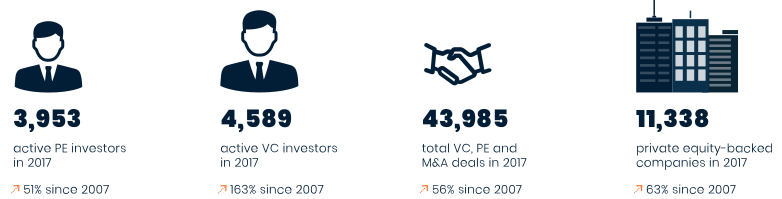
Investors have been flooding into private markets in ever increasing numbers. In 2017, according to PitchBook, there were 3,953 active private equity investors, a 51 percent increase from 2007, and 4,589 active venture capital investors, a whopping 163 percent increase from 2007.
The growth of the private markets, globally
Source: PitchBook Private Markets Guide
The number of private-equity backed companies during this period also rose by 63 percent and the total venture capital, private equity and M&A deal went up 56 percent. The result? The more money that flows into private markets, the more they grow in value and scope for both investors and companies.
Access to private markets is changing
Although private markets have gone from niche to an increasingly attractive alternative investment opportunity to public markets, due to seven figure minimums, they have mainly only been within the reach of institutional investors. However, this is also undergoing a change.
Wealth managers, for example, help provide individual investors access to booming private markets. Technology is also transforming the industry. New digital investment processes enable both wealth managers and individual investors to invest in private markets at a fraction of the traditional cost. As private markets continue to grow and surpass public markets, these new developments will grow alongside them, opening up private markets to a larger section of the population than ever before.
To find out more about how Moonfare is disrupting private market access for individual investors, please see here.