
To test how much value now accrues before listing, we compared three groups. The first is the seven most valuable technology companies that went public in the 2000s; the second is the eight most valuable that went public in the 2010s, both ranked by today’s market value. The third is the nine most valuable private AI companies founded since 2017, using their latest funding-round valuations.
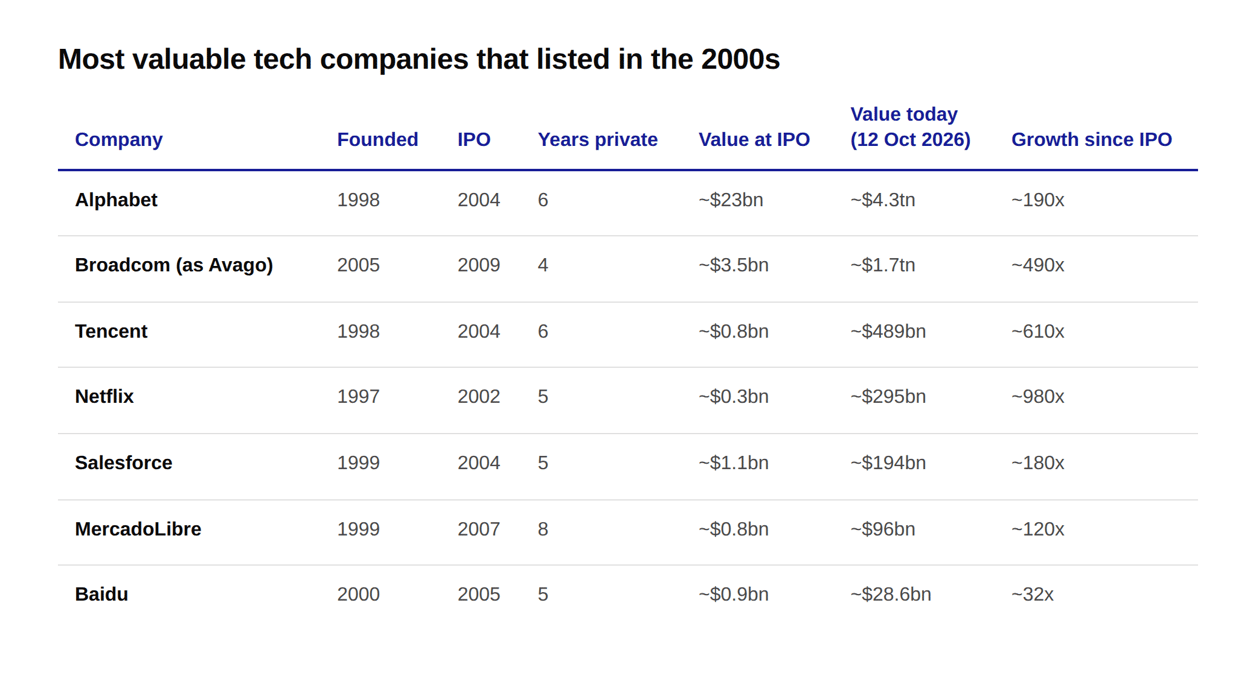
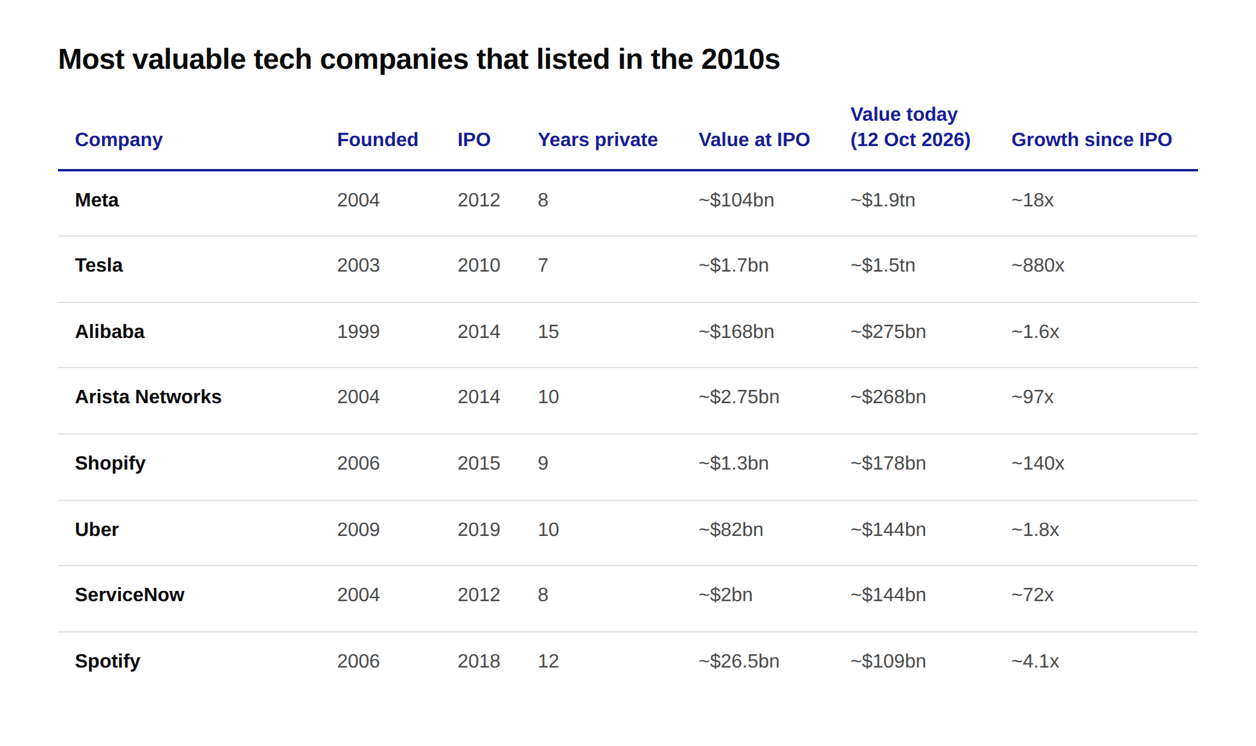
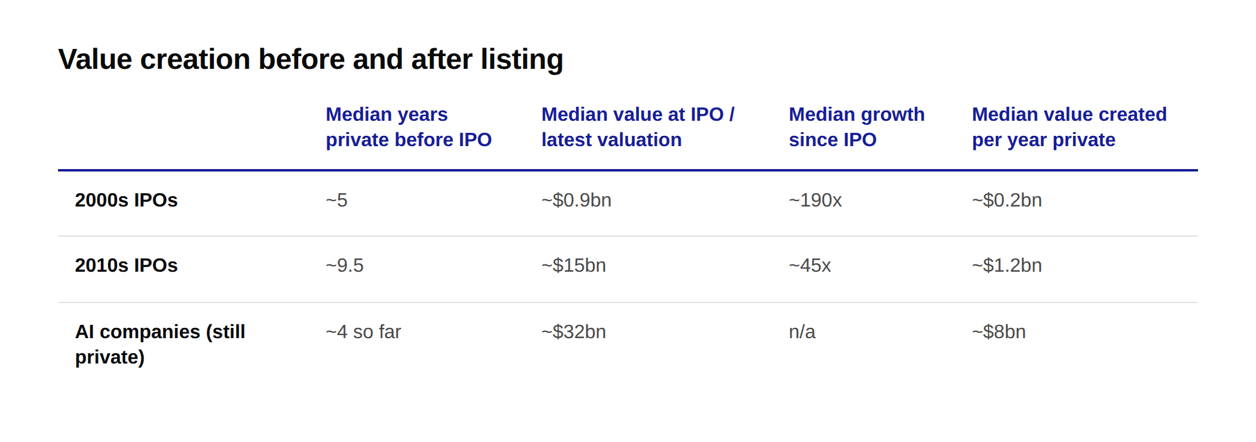
The comparison shows that companies have stayed private longer, listed at a higher valuation and left less growth for public investors. The 2000s generation, including Google, Tencent, Netflix and Salesforce, typically listed after about five years as private companies, at valuations below $1 billion. The 2010s generation, from Meta to Uber, stayed private nearly twice as long and listed at a median of around $15 billion.
Academic data supports this trend.¹ According to Jay Ritter at the University of Florida, the median US tech company that went public in 1999 was four years old and had annual sales of about $23 million. By 2021, the median tech IPO was 12 years old, with sales of about $234 million, ten times as much.
The more a company is worth at listing, the less public investors can gain. The 2010s companies, in particular, show this clearly. According to our calculations of publicly available information, those companies that listed small, such as Shopify and Tesla, have grown 140-times and nearly 880-fold, respectively, to date. Those listed above $25 billion have grown far less: Meta about eighteen fold, Uber and Alibaba not yet twofold. The same limits may apply to today’s AI leaders. A company that lists at $1 trillion would need to become worth around $20 trillion to match Meta’s peak market cap since its IPO.
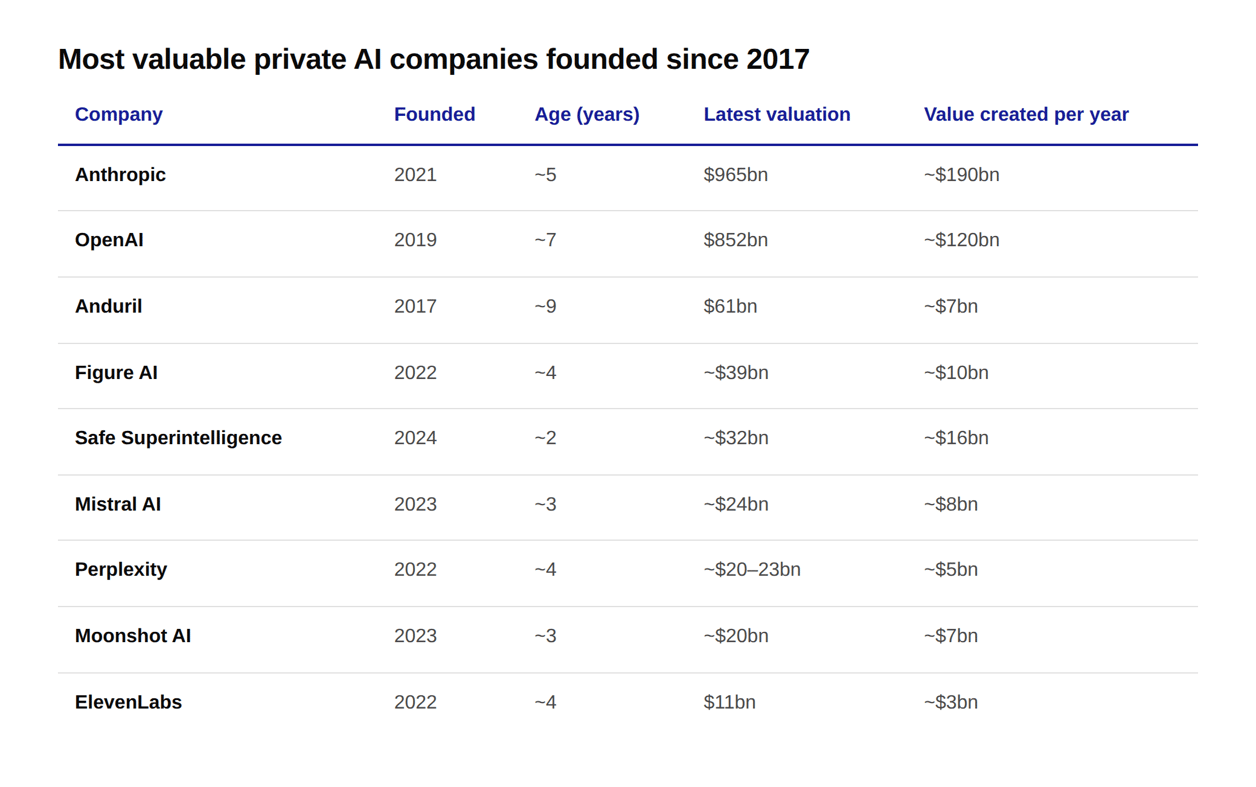
AI companies, currently considering listing, are relatively young yet the value they have created is without precedent: the median valuation of the nine companies in our sample is roughly $32 billion, which is more than most of their predecessors were on the day they listed.
Capital, early revenue and concentration of winners
We see three reasons why AI value builds so fast.
First is capital. Building and running frontier models requires capital on a scale that only very large private rounds and strategic investors, such as chipmakers and cloud providers, have so far supplied. Some of those investors are also suppliers, so valuations may partly reflect strategic motives.
Then there’s early revenue. Earlier internet platforms spent years building audiences before earning money from them; Facebook’s annual revenue was still under $4 billion the year before it listed.² AI products sell to businesses and consumers almost from launch. Anthropic’s annualised revenue grew from about $1 billion at the start of 2025 to $65 billion by August 2026³ and OpenAI’s passed $40 billion this summer.⁴
Finally, only a handful of AI companies will likely succeed to become long term market leaders. Investors are pricing a general-purpose technology in which they expect a few companies to capture most of the value, so they pay ahead of the outcome.
The result is that the median AI company in our sample has created around $8 billion of value per year since it was founded. The comparable figure is just over $1 billion for the 2010s companies and about $200 million for the 2000s generation (while these companies were private).
Many will never list
Companies heading for an IPO are only the visible minority. Most venture-backed companies exit through acquisitions or sales to other investors. This is a far larger group of companies and almost all of its value creation takes place out of public view. Cursor, the AI coding company, for example, was acquired by SpaceX for $60 billion four years after its founding, without ever listing.⁵ For its investors, all of the value was realised privately.
Exposure to this stage of a company’s growth is available almost exclusively through private markets: growth and late-stage venture funds for companies scaling towards an exit, buyout funds for AI adoption in established businesses and infrastructure funds for the data centres and power that AI requires.
Manager selection matters most
Across private markets, outcomes are far more uneven than in public markets. The gap between top- and bottom-quartile managers is widest in venture and growth equity,⁶ where a small number of companies drive most returns. Access is uneven too: allocations in the most sought-after late-stage rounds tend to go to managers with established relationships and a record of adding value.
For investors, the decision that matters most is not whether to invest in AI, but who to invest through.

¹ Jay R. Ritter, University of Florida, 2026
⁴ Bloomberg 2026 (subscription required)