
Key takeaways:
- Global deal count has grown in first half of 2026 even as total value declined, meaning GPs are still finding the right targets, just smaller ones.
- Tech buyout activity cooled as AI uncertainty complicated valuations, though defensible software models are coming into clearer focus.
- VC investment is increasingly dominated by mega-rounds, crowding out smaller funding activity.
The private markets picture so far this year is a split one. Global investment value fell in the first half even as deployment rose. Exits slowed in the US but stayed strong in Europe. Fundraising still feels subdued headline-wide, yet top managers are raising records. Moonfare’s mid-year report looks at where the private assets industry stands halfway through 2026.
High dealmaking activity, lower risk appetite
It was a mixed six months for dealmaking. Global private equity investment value fell 4% year-on-year and almost a quarter compared to the second half of 2025, per recent Pitchbook data.¹ The Iran war and the oil shock that followed delayed the rate-cut catalyst many in the industry had been counting on, keeping the cost of debt elevated and compressing the spread between operational value creation and the cost of holding leveraged positions.
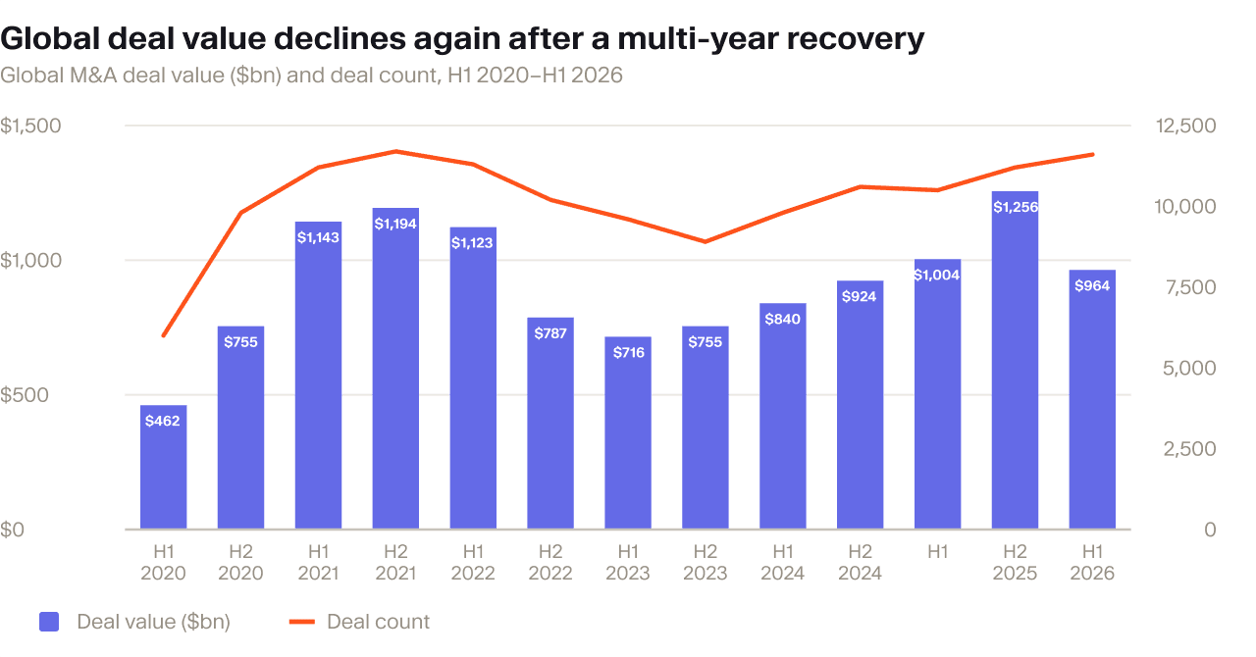
Dealmakers adopted a tighter risk appetite but they haven’t retreated. Deal count rose 11% in the US and 13% in Europe year-on-year, pushing the global — and European tally, in particular — toward record levels. GPs are still finding the right targets, just smaller and more conservatively underwritten ones.
Software absorbed the sharpest repricing. AI disruption fears drove the so-called "SaaSpocalypse", as public markets stripped valuation from recurring-revenue software businesses. The effect showed up in private transactions: value fell 70% from Q4 2025 to Q1 2026, according to Bain & Company², with fewer mega deals clearing.
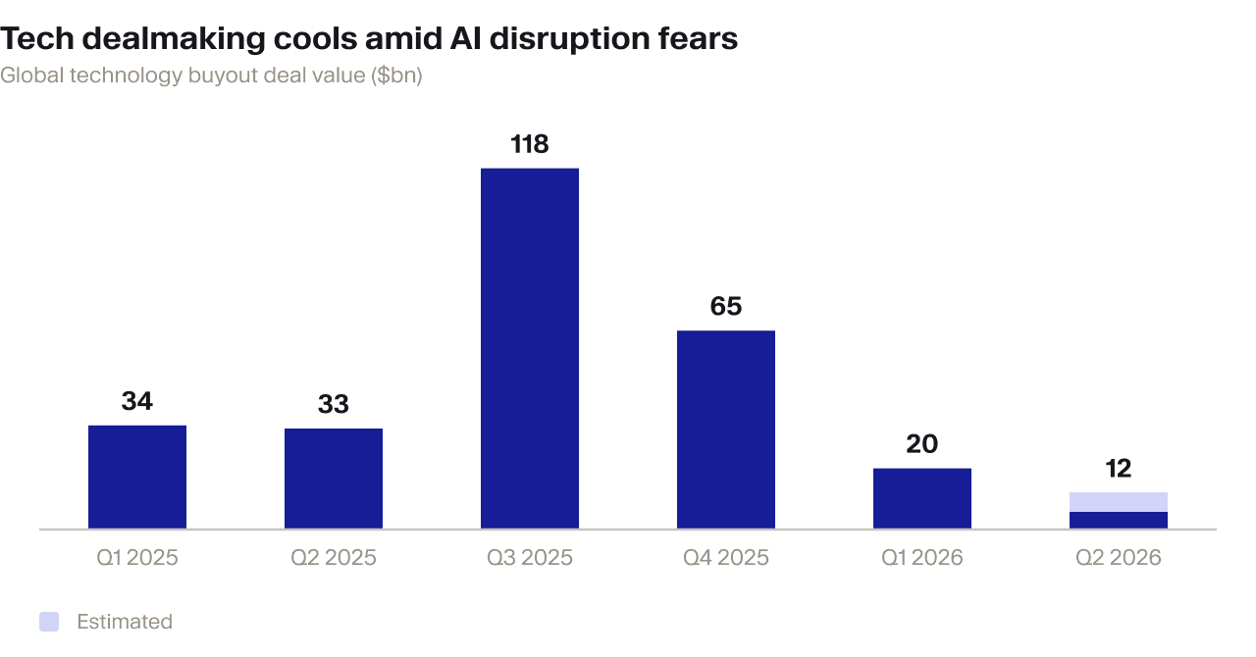
That's now slowly reversing as markets gained more clarity as to what makes a defensible software model. Hg, for example, recently agreed to buy California-based rights and royalties manager Rightsline for about $500 million including debt: a business considered hard for AI to replicate because its value sits in proprietary customer data³ and less in code. The same logic underpins Permira and Warburg Pincus's $8.4 billion take-private of Clearwater Analytics: an investment-accounting and analytics platform embedded in over $10 trillion of client assets, whose workflow integration means AI could deepen the moat, rather than threaten it.⁴
LPs are following similar logic: software remains a high-conviction allocation, but only through managers with an established track record and a credible AI thesis. Main Capital, a European manager based in the Netherlands, for instance, just closed a record €5.2 billion across its two funds, aimed at profitable enterprise software businesses. The firm believes “AI is unlocking a new wave of growth and value creation opportunities”.⁵
Mega AI deals dominate venture capital
If private equity deployment is cautious on size, venture and growth shops are moving in the opposite direction by chasing fewer, but larger bets in AI.
More VC dollars were invested in US companies during the first half of 2026 than in any full year on record. PitchBook ($412.7 billion in the US)⁶ and Crunchbase ($510 billion globally)⁷ both point to the same concentration: AI absorbed 86% of US and over 70% of global venture dollars in H1 2026.
Headline number was driven by mega-rounds as four out of five dollars went to deals of $100 million or more. Within that group, the concentration goes further still: over 40% of all capital was raised by just two companies, OpenAI and Anthropic.⁸
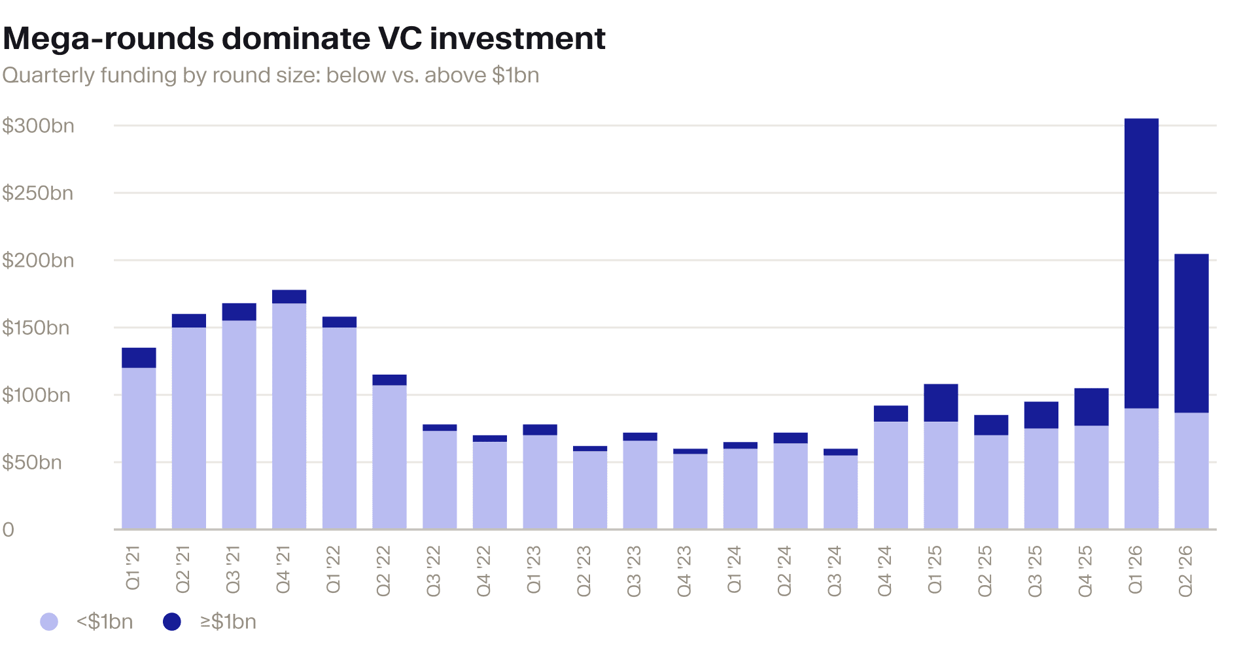
Overall, Crunchbase counted 16 companies that raised billion-dollar rounds, including China-based foundation model companies DeepSeek, StepFun and Moonshot AI, UK-based Ineffable Intelligence, and US-based labs Prometheus and Isomorphic Labs.⁹ Alongside foundation model companies, large rounds were also injected into startups in AI infrastructure, robotics, healthcare and defense. Helsing, a German AI drone-maker, for example, recently raised $1.8 billion in fresh funding at a $18 billion valuation, as “investor appetite for military tech continues to accelerate”.¹⁰
This concentration cuts both ways though. If even one or two mega-rounds slow in the next half, the growth figure could reverse sharply, since much less of it is being carried down the VC market.
Many exits are still in limbo
Turning to exits, the impasse hasn't broken entirely just yet. Global exit count has declined for two straight quarters, per Pitchbook.¹¹ While managers are finding ready buyers for top-quality assets, many other portfolio investments remain in limbo. Markets are grappling with the effects of ongoing geopolitical conflicts, trade tensions and the impact of artificial intelligence, all of which are contributing to a buyer-seller divide.
The entire value of this year’s exits nevertheless spiked 12% year-over-year to $618 billion, but that gain traces almost entirely to one deal, with roughly 40% of dollars coming from the x.AI–SpaceX merger.¹² The seller group included some of the most established VC firms such as Sequoia, Lightspeed and Andreessen Horowitz.
Other sponsors also found ways to clear inventory. Carlyle sold US-based Copia, its data centre power and infrastructure platform, to EQT, and is set to make a more than fivefold return from the $2.6 billion deal, per Financial Times.¹³ Kohlberg sold Entrust, an engineering services firm to a strategic buyer,¹⁴ while Blackstone listed Liftoff Mobile, mobile app marketing platform, onto Nasdaq.¹⁵
Public listings, in particular, are gaining momentum: value of PE-backed IPOs in the US rose to $27.6 billion, up staggering 283% year-on-year, though that figure says more about how weak last year's base was than how strong this year is. The recovery is concentrated in B2B sectors like industrials and aerospace, which are the segments public investors can underwrite with the most confidence right now.¹⁶
Still, the LP community wants to see a significantly higher level of exits, pressure that is changing GP behavior: more managers are conceding on price rather than waiting for markets to validate last year's marks, according to the S&P.¹⁷
That concession has a ceiling. A recent ILPA poll, cited in Bain’s report,¹⁸ found a majority of LPs start losing confidence in a GP once an exit price falls 5% or more below the most recently reported valuation. The price flexibility GPs need to clear inventory sits in direct tension with the trust they need to raise the next fund.
Europe is going strong
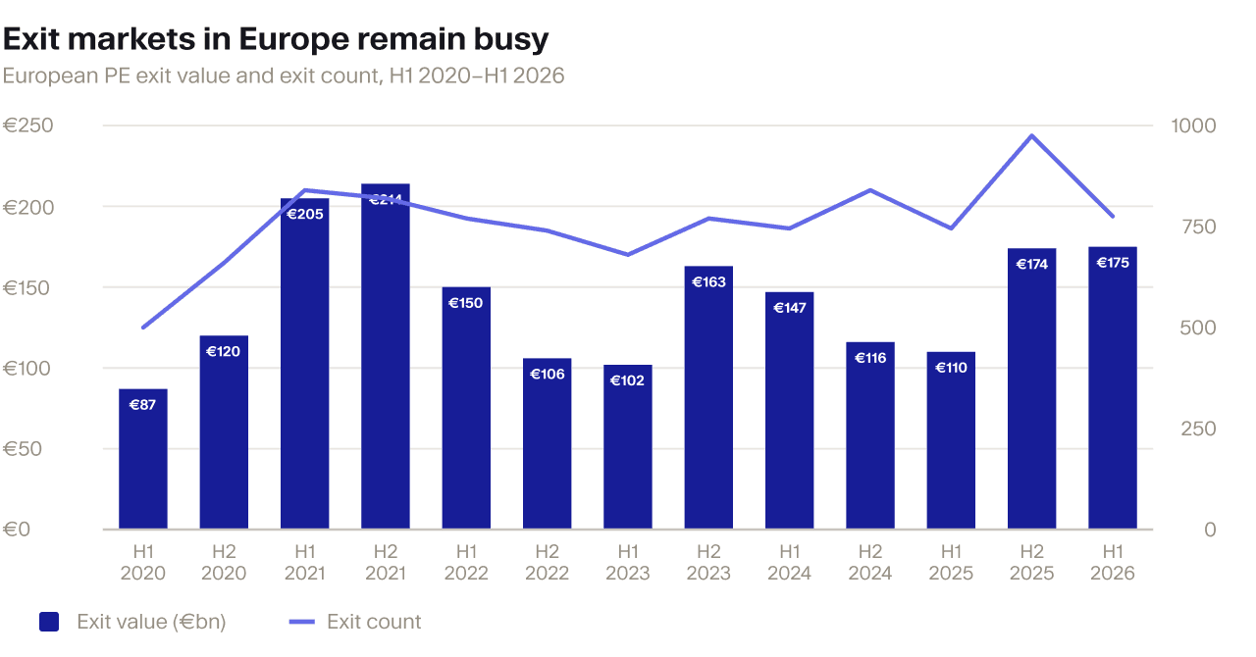
Regionally, exit value declined in the US in the first half, but rose 59% year-over-year in Europe — though that growth is carried almost entirely by its largest deals: Pitchbook counted 22 mega-exits accounting for two thirds of Europe's €158 billion in Q2 exit value, well above the average of the past decade.¹⁹
The TK Elevator sale is a good example of what's clearing on the continent lately. Advent and Cinven sold the business to Finland's Kone, another maker of elevators and escalators, for €29.4 billion, generating roughly €12 billion in value creation since carving it out of German Thyssenkrupp for €17.2 billion in 2020²⁰ (the deal is structured partly in stock, so the gain isn't fully realized).
The investment is textbook: enter the business at lower entry price, from a distressed conglomerate, grow operating profits, then sell to the one strategic buyer positioned to capture most of the synergies. “Cinven and Advent followed the private equity playbook to the letter,” Financial Times noted.²¹
Fundraising: is the downward trend reversing?
Even with exits recovering (unevenly), years of accumulated backlog are still filtering through to fundraising. Global fundraising in H1 2026 tracked to a pace below every full year since 2020²² with the exception of last year — annualising the run rate puts 2026 ahead 17% compared to 2025 total. This is a good sign that fundraising drought may be loosening, even as it concentrates in fewer funds: only 310 vehicles have closed in the first six months which is the lowest half-year count since at least 2016.
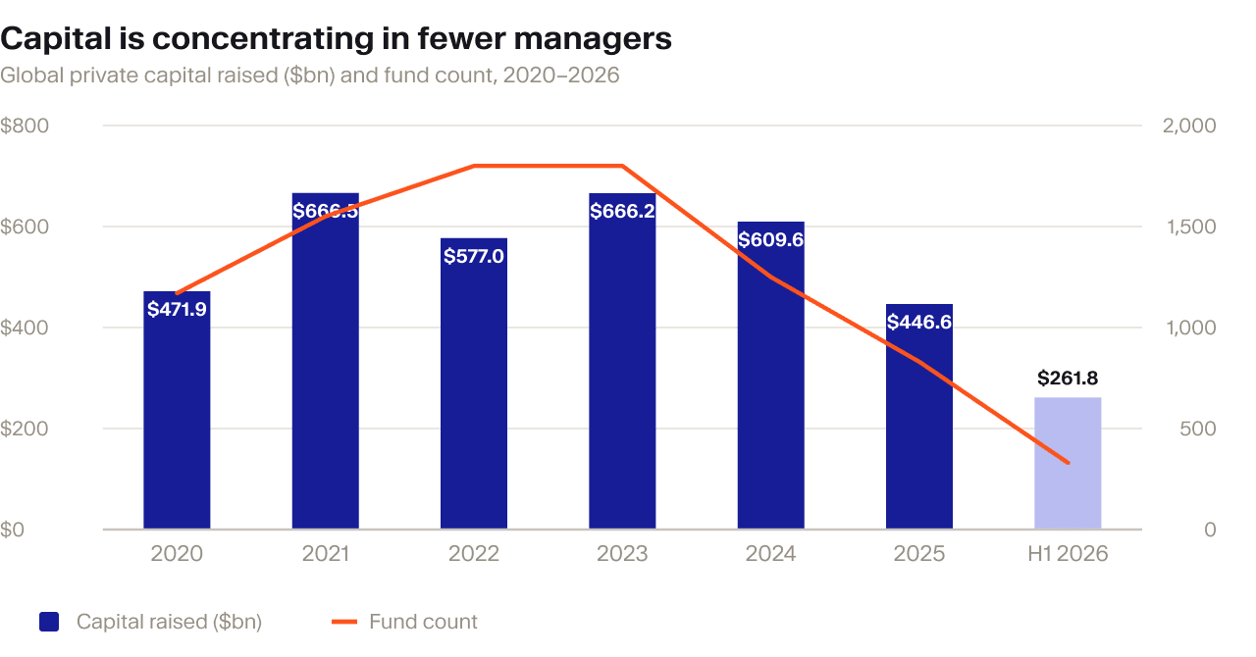
The aggregate figure masks a starker story of two speeds. The top 300 fundraisers, as tracked by Private Equity International's annual ranking, pulled in a record $3.6 trillion over the past five years — an 8% increase versus last year's report²³ — while the rest of the industry runs behind annual historic averages.
As we’ve noted in our recent report, the market is consolidating around fewer managers, with investors extending existing relationships rather than initiating new ones: around 70% of recent commitments went to existing GP relationships. As distributions have stayed below 15% of NAV for four straight years running²⁴ LPs started prioritizing realized returns over paper marks. The effect is a fundraising market that increasingly looks more and more concentrated and selective.



¹ PitchBook, Buibish, Moura, Tan, 2026
² Bain & Company, MacArthur, Burack, De Mol, Schmitz, Krim, 2026
⁶ PitchBook, Stanford, Zheng, Gao, 2026
⁷ Crunchbase News, Teare, 2026
⁸ PitchBook, Stanford, Zheng, Gao, 2026
⁹ Crunchbase News, Teare, 2026
¹¹ PitchBook, Buibish, Moura, Tan, 2026
¹² CNBC, 2026
¹⁴ PE Hub, Manayiti, 2026 (paywalled)
¹⁶ PitchBook, Buibish, Choi, Hinds, Walters, Tang, 2026
¹⁷ S&P Global Market Intelligence, Thomas, Bharucha, 2026
¹⁸ Bain & Company, MacArthur, Burack, De Mol, Schmitz, Krim, 2026
²¹ Financial Times, 2026 (subscription required)
²² PitchBook, Buibish, Moura, Tan, 2026
²³ Private Equity International, 2026
²⁴ Bain & Company, MacArthur, Burack, De Mol, Schmitz, Krim, 2026